Showing posts with label wargaming. Show all posts

Monday, 31 December 2018

A wargaming year…


Okay it is the last day of the year, I am contemplating the Lucullan dinner awaiting me, and taking time to write some (understatement) lines about 2018 and wargames. Plenty of bloggers do that… after all it is quite normal to look back in such a day (before filling our stomachs and forgetting everything). I will say it has been a positive year for the hobby in general, and for my corner of it in particular. We saw plenty of new releases, good and bad, more good than bad, and I was able to play and paint several of them. Even the computer side of it has been good, with the new Combat Mission Shock Force 2 released, The Operational Art of War 4 and other little things. Basically a good year for the hobby… and the Perry twins’ early XV century cavalry is arriving in a couple of week…

Yet despite all the positives there are some negatives (no I am not talking about personal ones). The hobby community is more and more divisive, crap is still coming out, and there are some uninspiring trends. I would say that the negatives are more about people than the hobby in itself, and certainly they concerns people who get publicity… basically I am quite pissed off by the ‘public face’ (there is one?) of the whole wargaming hobby. More often than not the hobby appears to be represented by its lesser lights, certainly the more aggressive.

I have already written a tirade against Facebook groups few posts ago, but to be quite honest some of the issues that plague these groups are also plaguing the big wargaming websites (rather than forums) across the internet. Basically the issue is one:

What I do not like deserve to die.

I play games on maps...

I play games with miniatures. And to respond to Brian painting and building them is part of the hobby, and result is warranted. 


Well I am the first to say that plenty of people deserve to die, I am a military historian by trade and one thing that history teaches is that sometimes deaths are necessary and inevitable… but usually these concerns evil dictators, madmen, and pesky colleagues (and maybe politicians whose asses are glued to their comfy chairs…). I am not really interested in seeing particular strand of the wargaming spectrum dying, neither to see companies disappear (okay FGA excluded… but well, how many supporters FGA had ever had?).  Yet, if you look around there is plenty of negativity. In his end of year summary for Wargamer.com, Colonel (USA RTD) Wilbur Gray made a quite scathing prediction for board wargaming, hex and counter will die, GMT and Decision will disappear, Compass (that it happens to produce hex and counter wargames!) will thrive on their carcasses.  Of course miniatures and computer wargames will not be affected by gloom and doom. Of  course it is no secret where Bill Gray’s sympathies’ lay. On the same token, other commentators  (admitting their previous failures in predicting wargames’ future) again predict the collapse of hexes and counters and the eternal rise of CDGs! Or something else, like War-Euros combinations and the like. Other people predict the demise of miniatures for computer games…

Basically everyone, his brother, and their aquarium fishes make wild prediction centred on the thriving future of their favourite kind of games and the demise of the rest. There is the underlying idea that only on aspect of our varied and storied hobby is worthy of salvation. Plenty of these predictions have come to pass, and we are still playing, designing, and publishing a wide array of different wargames.

Because all the Cassandras, and the other assorted Sunday’s prophets that had seen the light in computer wargames and the dark in other kinds… have failed. Funnily enough the first of these two cents fortune tellers, James Dunningan left the field to become a third (or fifth?) rate strategic expert. The idea that computers killed board wargames is a dead, putrefied, skeleton horse. It stinks. Yet it is still around… like the myth of the German military invincibility (read one of the latest articles by Ty Bomba to be treated to the uber-Germans winning the second world war… no, wait… they lost…) it is a myth that is never ending. Back in time, reflecting on the demise of SPI James Dunningan blamed computer games for the destruction of paper wargaming. Of course there were lot of other trends involved (and also Dunningan may have had a big personal role in the fall of SPI, and tried to cover it up), and board-wargaming did not die at all, despite Dunningan analysis. Yet the idea that somewhat the hobby is relying on a flat base of older gamers who survived its heydays is often casually thrown in discussion. The recipe to stave off disaster is, we are told, crossover games, and moving away from traditional wargames toward computer. Often these calls are coupled with accusations of male dominated hobby, snobbism against fantasy or science fiction. More often than not there is a tone of impending doom… change or be swept away. Each of these elements has its champion or champions.  Yet the underlying impression a moderate gets is… ‘I do not like game XYZ so it has to be bad and disappear’. And then there is the unanswered question… why?

Then you have the people that claim hexes and counters are dead, and cards, areas, and meeples will rise… it is the current CDGs crowd, or the current COIN crowd. Yet, Card Driven Games have been around for a while, and they are not so new. They have not supplanted hexes or counters. Plenty of them uses counters, and some even hexes. It is worth to note that their boom as passed, and while they are not going away (and why they should?), they are just become part of the whole hobby. Cards are used also in Miniature Games (I ain’t been shot mum anyone?). It is a worthwhile mechanic but not an end unto itself. And we had plenty of crap and bummers in this department.

Then there is COIN… the new grail… except that despite a couple of good games, the whole series is sliding down the crappiness and some designers force COIN on the throat of everything… yet you have people arguing that COIN will supplant everything else, and everything else is destined to rot in hell…

It is disheartening to see so many people relishing in their prophecy of doom for entire segments of the hobby. Even more disheartening because these prophets looks quite shallow, and their arguments take up places that could be used for more useful endeavour, like informed discussions, and reviews. Frankly, who cares if a computer games expert bashes board games? Does he know what is talking about? Short answer, only people who dislike board games care, and he does not know anything.

Thankfully, like Dunningan prediction and analysis (that hide his own poor decisions in SPI…) these prophets are basically rubbish. Let’s paint a better picture… maybe, one based on real knowledge. I will start from computer games. Recently on the Facebook wargamers group the idiot of the day (If you want I can provide Facebook names too, after all Marck Zuckenberg does it all the time…) said that the relation of  board wargames to computer wargames is like that between VHS and DVD. Persuading young people to play board wargames over computer games is like pretending people to go back to VHS from DVD. Okay… 

There are deep issues in this view. Basically, it is just an outgrown of Dunningan’s claims of PC games killing board ones. New technology always supplants existing one.  The underlying idea is that board games were somewhat inferior to their electronic counterparts and more expensive. But, when Dunningan was pontificating not only electronic wargames were in their infancy, they were few, basically crap, overpriced and relied on hardware that, until sometime later, was extremely expensive.  A single pc game could have been not too expensive, but it needed a computer that was not readily available to everyone. This even before addressing issue like quality, AI, and playabilty. I saw some of them, and they were quite subpar. Basically Dunningan was talking hot air, like he does in his strategy page… old habits never dies.

The Moderns have at least the benefit of cheaper hardware (but how cheap is a computer rigged to play the latest games?) and better games. PC wargames have evolved and some are innovative, interesting, well researched, and engaging.  So at least they have something to show. Now there is an issue that cannot be denied, I cannot deny it too. Computer games sales far outstrip traditional wargames one. Fair point, but one that is also completely irrelevant.

We are comparing apple to oranges, and even in a bad way. The issue that what I call the ‘PC doom crowd’ fail to address is what a computer wargame is. Nitpicking? No. It is the heart of the issue. How many computer games that really qualify as wargames are sold? What really qualifies as computer wargames? If you just pull out the average Joe from the street, if you can get an answer at all it will be Call of Duty or Warcraft/Starcraft, if you are lucky a Total War game…  But we have a deep issue, computer games that are often called wargames by the press and the public are not wargame in any sense. There is very little relation between Call of Duty and ASL as there is very little relation between Rome Total War and Imperium Romanum II. I have seen this with students. They are quick to think of them as wargames because that is what they are told. But wargames they are not. Also they appeal to different people. Yes there will be overlap, as there is overlap in everything, but this is not changing the reality. Real wargames are a minority even in the PC market, their sales are not that big, computer games in general did not steal the player base of wargames.

Once you remove the oranges and remains with the apples it is also interesting to see what the apples are. A lot of PC wargames are tactical in nature. There are very few operational or strategic ones. Also players often criticize board-wargames for their lack of details. I remember a discussion on RPS Flare Path column on Phil Sabin’s Simulating War book. One of the posters was complaining on the limit in the level of detail of any ‘manual’ game compared to games like War in the East. Fair point, but…

1     1) He did not really read or understand Phil’s position about details
2)  2) Despite disagreeing with Phil’s emphasis on abstraction, I am persuaded that details do not equal realism by default. Just because a game track each infantry squad on the whole Russian front it is not more realistic than one who only track army corps.

Again the computer player in question is attracted to detail in a way that is outside the scope of any playable manual wargame (much better definition that board wargame, let’s use it!). I play computer wargames and manual ones. I find very little overlapping. I found them not very related. I also play Total War, and have played several Call of Duty and Medal of Honour games. Let’s leave CoD and MoH alone for now.  They were never wargames to start with, and, right now, they are also bad games more concerned with campy multiplayer, scripted movie sequence, and very little with any meaningful conflict simulation aspect. Also, they are not wargames, they are first person shooters. They are the brothers of Doom rather than ASL.

Total War and other RTS or even 4X turn based games are, often, hailed has wargames or historical games, but they are not wargames at all. They have war and conflict, but grouping them together with manual wargames would be wrong. As it would be grouping together their player bases. It is worth noting that some RTS have evolved in the so called ‘E-sports’ and are nothing more than click fest.

Even serious title like Steel Beasts Pro or Combat Mission are games that is difficult to pin together. They are apple and oranges by themselves, and it would be very difficult to find equivalent in the manual wargames library, especially for title like Steel Beasts (they are simulators, again a different beasts, notwithstanding the idiots on BGG and other places that confuse simulation with simulator). Combat Mission (especially the first series) feel like a miniature wargame, but for now we are focusing on another genre.

The bottom line is that computer and manual wargames scratch different itches. On top of that perusing game forums I have seen very few people who are even aware of the existence of manual wargames at all… my experience in KCL Conflict Simulation class, and in Wolves ‘Virtual Warriors’ module is that while there are more students familiar with computer games and manual wargames, there very little in the way of ‘I stopped playing manual wargames because the PC ones were better’ often the computer crowd is stuck on total War, Paradox grand strategy (and often they do not care too much about the level of historical details), and CODs… on the other hand some students dismissing manual wargames as obsolete by default in September came to different conclusion after having played and designed games at the end of the module.

What I see is a large, healthy base of publishers doing manual wargames, and other doing computer wargames. Their catalogue are strong and varied. Their titles cater for different interests, mechanics, and players’ inclinations. Each medium, and each title has its own strength and weaknesses. It is worth to mention that while there is an overlap in players, (and I just played Slitherine’s intriguing Panzer Doctrine…) the players seem to be two largely discrete communities.

Bottom line: the boom in real computer wargames happened after Dunningan wrote his nonsense. It even happened after the fall of Avalon Hill, and the dark age of manual wargaming. Probably they are two unconnected phenomena.  Yet this myth is still with us, and duly resurrected when the idiot of the day wants to explain why manual wargames are a doomed hobby. Nonsense. We can just play our games in peace.

Now let’s move on… the second big myth. The new holy grail game technique that will rule them all… give me a ring please… Even better is it is a crossover to euros.  The crossover that will suddenly bring thousands of eager new players in the hobby by virtue of its simplicity and appeal (and low price!). I think everyone hopes for it… I think everyone with a working brain knows it is just rubbish. There are several wrong assumptions at work here. First of all is that you can entice people to become wargamers just hanging an easy game in front of them. After you have hooked them they will simply move to more complex games, finally they will all play ASL!   I do not think this is making any real sense.

First of all, there is an assumption that one size fits all, be it players’ interests and game mechanics. There is also a mental limitation at work, that one mechanic can cover everything. This is a phenomena that you can see both in board and miniatures wargames. There was a recent article on Wargames Soldiers and Strategy waxing about the idea that a single mechanics can simulate everything at every scale, from Sumer to Ramadi… I scratched my head… and mentally binned the author in the realm of idiots. I am sorry to use such a term but it was just a demonstration of the lack of understanding of warfare and its modelling. Okay… it could provide food for the game vs simulation debate. But here is serving another purpose. An historical wargamer, one who understand history, will scratch his head if an Assyrian chariot is simulated in the same way of a French 1812 Cuirassier. Even more if an unit of chariots and one of cuirassiers are modelled in the same way (I mean their functions, not they physical models!). Yet the one game to rule them all crowd propose exactly this. What we can call… the Sauron’s technique… will replace everything else. Sadly for the prophets, luckily for everyone else (including the prophets of the different Sauron’s technique…) it will not happen. Despite the claims that the new games will replace the old it will not happen. They will just sit together on the same shelf.

IF we look at the past of the hobby it is something that happened all the times. Everytime a new mechanic was introduced the players were divided in camps, some outspoken supporters, some claiming it was just a fad (why? Was it used improperly?), and the silent majority buying what they like, and leaving on the shops’ shelves or website the games they did not like. Some designers become fixated on certain mechanics (Mike Rinella and its area/impulse, who is simply saying the approach is better than anything else, without explanation), some rejected it, most simply adding it to their libraries.  Nothing new, no impeding collapse, despite every time someone yelling at the ultimate mechanic. Still… people continues to search for a grail that looks more like the Ring… nothing holy, just a chimera that, once reached is only a curse… remember the end of the Fellowship… there is no rule to rule them all.

But it is not just the random poster on Facebook or BGG that clamours for it. Years ago, boardgame (be careful, Boardgame not Wargame…) designer Lewis Pulsipher, the creator of Britannia claimed that wargames were destined to irrelevance because our games do not have plastic components, area maps, and are too complex. Okay, if someone creates an idiocy guided cruise missiles Pulsipher would be a perfect guinea pig to test the guidance system. Yet beside the fact it was just an empty, baseless, claim by a second class designer and smelled more of self-advertisement than anything else, it highlighted the issue at hand. More often than not people use the internet, or even game magazine not to discuss issues, but to do negative promoting, criticizing other products and approaches to promote theirs. Wargames are not bad. Wargamers are bad. There is this habit to knock off things to sanctify others. Wargamers are not the only culprits, historians and strategic analysts are even worse offenders. Lewis Sorley is a master of it, launching vitriolic attacks on General Westmoreland just to make a saint of Creighton Abrams. And what about the dean of all strategic forgers? Basil H. Liddell Hart?


You need counters... put such information on a plastic meeples... or produce a similar map with areas... sorry mr. Pulsipher, you do not know what you were talking about...


Even stellar figures in the hobby fall prey of it… I remember reading a piece written by my favourite Miniature Wargamer designer, Richard Clarke, the Lord of Lard… dismissing manual map based wargames, and telling the readers they were dead… He had bad experience playing the Europa series back in time and written off, thousands of titles… and a vital strand of the hobby. I was reading about divisions moving at a glacial pace over the Russian steppes. At the time I was playing the new edition of Red Star and White Eagle from Compass. And it was not division moving a glacial pace, it was the Konarmya racing forward, and then the Polish counterattack… it was exciting… it was engrossing… it was a fight for a country, rather than a fight for a village.  It made me think twice about the usual engagement with Rich’s Chain of Command or IASBM. Yet I like both approaches. I do not knock off one or the other.

What I found irrelevant of this approach is that the Sauron’s technique is not a solution, is part of the problem. As me and Phil said to countless cohorts of students, there is no right or wrong way to design a game. There is no perfect answer to every problem. This is exemplified with the different approach me and Phil takes to design. Loom at my own games or the games I have worked with (easy go to BGG and look up to game designer Arrigo Velicogna), and do the same with Philip Sabin. You will see plenty of differences in approach. Even better for today discussion you will see that even our games tend to be different between them. Some designers are just iterative, some are instead letting the situation to dictate the technique to be used. Plastic meeples? Fine as long you do not want plenty of information on your game pieces. Miniatures are better than counters, at times they are, at times they are not. Variety is the key. The final game does not exist. The ‘evolution’ that some closed minds see is only a nightmare for us.
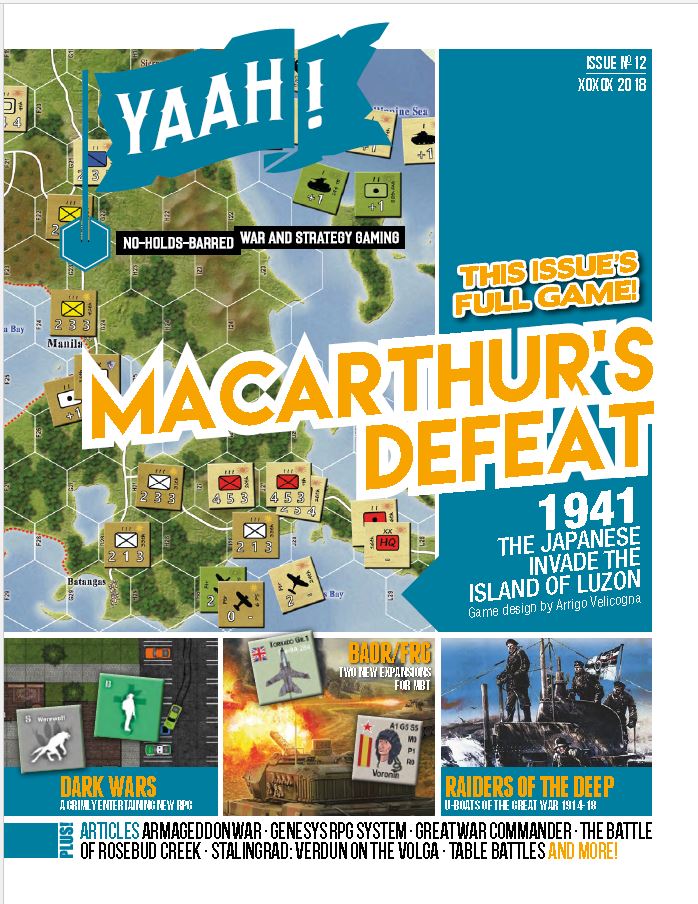
Plenty of new games on different subjects, with different mechanics, including mine.


Well… it was along post… and one quite negative on wargamers, but, I am persuaded, positive on the hobby. I am sitting on my uncomfy chair right now. I can see part of my collections of wargames. PC, Miniatures, Board. They are varied, they are exciting, they are an important window over military history. Some are easier, some are more detailed, some are broad brush approach. The bad ones… well I tend to avoid buying them, trade them, sell them,  or put them somewhere else… I also have my list of eagerly awaited pre-orders. Under the trees I had Iron and Oak, Tinian, and War for the Union (2nd Edition). A broad and varied lot! I also got TFL annual magazine with new rules and scenarios. And a couple of games on steam too. Right now there is nothing on the table, I borrowed it to my mother for her Lego city… But I am looking confident on the future. There are plenty of interesting project approaching completion. Adam Starkweather is finishing his operational game on Vietnam, a Rumor of War with Compass, and two new games of his company scale series. GMT has a new Next War game coming, and Bruno Sinigaglio big game on the Ardennes (and Compass has Danny Parker reworking his Bulge Masterpiece. MMP has a TCS game on Bir el Gubi, the Ariete armoured division giving a bad day to the 22nd Armoured Brigade, a rubbing generations of British historians, blinded by their arrogant, baseless, and racist contempt for Italians, and slavish admiration of a nazi like Rommel, have always attributed to Germans… (that for that idiot Capitan Blood, that on the Lead Adventure Forum claimed that the Italian experience in North Africa was only shoddy and sorry… an insult to my country, my Army, and myself as a former Italian Army Cadet Officer… another star display of historical ignorance)

The past year was good, the new year looks even better.

Go Forward Wargaming

And Best Wishes for a great 2019 to my readers!

Saturday, 9 December 2017

Jacob Devers' tank, the M26 Pershing

In 15mm, of course...

In 1943 General Jacob Devers, then head of the Armored Command, took a strong interest in developing a new heavy tank to dela with the German Tiger tanks, recently encountered in Tunisia. In response ot his request the Army Ordnance Department start design work on several new projects including the T-23 with electricla transmission (a pet peeve of Ordnance) and the T-26 with a 90mm gun. These programs faced severla issues, from the simple fact the T23 and its transmission was not working to resistance from several officers led my the all powerful chief of Army Ground forces, General Leslie McNair, to the idea of a 90mm tank. Finally a new heavy tank the T26 (later standardized as M26) Pershing. If you want  a more detailed account go there:

http://www.avalanchepress.com/Pershing1.php

http://www.avalanchepress.com/Pershing2.php

or even better grab a copy of Steve Zaloga's 'Armoured Thunderbolt' if you just want to look at the 15mm version...

scroll down!

 (reduced) Platoon shot. All three, BF plastic Pershings. They can be or a reduced strength platoon, or the heavy section of a full platoon.

 Platoon commander tank.


They are nice models, crisp as I got used with BF plastic. I have to say that while some people whines about the plastic move, I find the plastic model a massive improvements. The MG are much much better, and the parts fit better than the the older resin-metal combination. I have recently built two M51 Ishermans and they were a real pain. I will say plastic yes, but the resin/metal vehicles are a no go right now, especially if I can get them in plastic or from other manufacturers. For the quality provided the price is overblown. While the plastic are still more expensive than PSC, at least they are overall cheaper than the metals and the quality is usually much better.

Sunday, 10 May 2015

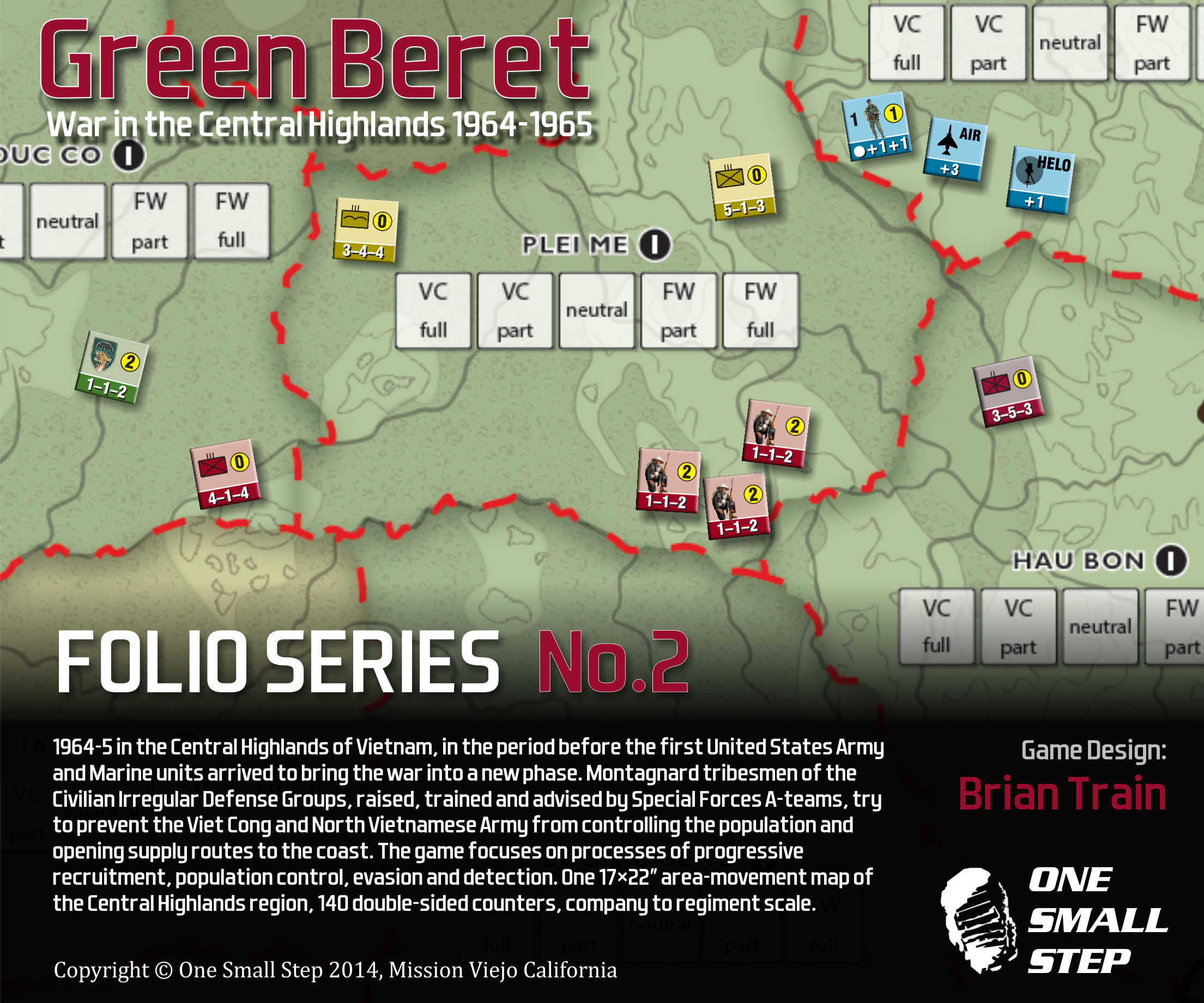
Brian Train's Green Beret


Green Beret,

A cardboard journey to the Central Highlands


Recently (ok several months ago) my friend Brian asked me to have a look at one of his latest games. Green Beret, a revision of his old game on the US Special Forces and local militias action in Vietnam Central Highlands between 1963 and 1964. Being an expert on Vietnam (not a self appointed one, beside my, hopefully, soon to be published book on the subject I have presented at several seminar in King's College London and at the Institute of Historical Research in London on the topic) and liking Vietnam wargames I just jumped in. 

Before the deployment of ground combat units in Vietnam in 1965 (but air and helicopter units were trickling there from 1962 onward).  The CIA firs,t the US Army Special Force later tried to stem the tide of communist infiltration from Laos and Cambodia creating a long string of camps along South Vietnam border manned by American Green Berets and local militias. These militias were recruited from the various non Vietnamese Montagnard tribes that lived along the two sides of  the Annamite chain. These were Nung, Bru, Meo, Hmong people who had different customs, language, and culture from the settled lowlander Vietnamese. They had always been considered foreigners (or even barbarians) by the town settlers of the coast and often mistreated. The French had found them quite happy to side with them against the lowlanders. They fit perfectly on the US COIN approach to use local groups to fight communists. In exchange for concessions (and a lot of promises) from Saigon, aid and weapons from Washington, and a lot of persuasion they agreed to fight for Diem and his successors against the invaders from the North. The Civilian Irregular Defense Group (CIDG) was thus born and a long page of the history of the US Special Forces started. 

Green Beret sends you in the central Highlands around Kontum and Pleiku. It is a game for two players. One player controls the Free World Allies (FWA, it was the official acronym at the time, I do not see any reason to change) and motely collection of US special forces, ARVN (South Vietnamese) regulars, and local Montagnards. The other player the VC player (do you need an explanation for this acronym?) controls both local troops, North Vietnamese coming from Cambodia and passing themselves for local communists, and, finally, a smattering of Hanoi's regulars.

Disclaimer and a first rant...
Ok first an important disclaimer. I have not played the nice looking version of Green Beret from One Small Step Games with die cut counters and professional graphic, but the DtP version from BTR Games.  This led me to a big mess... being BTR games accustomed to the North American tradition the map is designed to be printed on Legal size paper... but living in Italy Legal paper is impossible to buy so I had to use A4 paper and shrink to fit (in two sheets) and that resulted in having the maps a little small for the counters, especially in the tracks... now it is so difficultt for members of the NATO to use the same paper standards? What is the point of having the western world using two different paper standards? Well this remind me of a discussion between an US Army officer and a British Army Reserve Officer at a NATO conferences... they discussed for hour of wargaming scenarios. For my BA friend a scenario is... well what a wargaming scenario is supposed to be. For the US officer it was a database... here goes NATO coordination... ok ranting done... back to reviewing...


Introduction

If you look closely you see why I was ranting... but the map is quite nice.


Once you open the virtual ziplock bag (or envelope)  you find a map, a slim rules booklet, a series of charts, and some counter-sheets that you have to mount and print. Everything in my virtual copy was in fighting order. The Map is quite nice. It is area based (more or less each are is a district) and the area grid is superimposed on an actual topo map. It gives you a good period effect even if the areas looks like bricks on a wall. They are lined up rather well. Pictures of the "standard" edition I have seen show a more usual area maps, but the BTR games edition has a strange effect. Mind you nothing is hampering your game play, but the effect is like a wall. The counters are workmanlike with rather nice pictures. The A Teams have a smiling Green Beret (taken for a real contemporary photo) while on their back they have the observation  tower of an CIDG camp. The other units have mix of icon and NATO symbols. Everything is rational except the strikers that have a static garrison symbol and the ARVN Rangers tha,t instead of having an airborne ranger symbol have a paratrooper one and that made me always thinking of the ARVN Airborne, not that far fetched considering the red berets were indeed used there, at Plei Me and Duc Co... in the latter camp the battalion adviser was a certain Captain H. Norman Schwarzkopf.  Once mounted the package is fine as it is (except for my previous rant... but this is not Brian's fault... this is lack of standardization...).

I will not dwell on the sequence of play or other rules because there is a complete example of play available on OSS Games website that will explain you more or less evertyhing. The bones are:

Each turn is around two weeks in the dry season and get longer during the monsoon.  In the turn there is a variable number of action phases (in pair, one for the FWA and one of the VC) and each phase has a variable number of operations in it. These number are determined by the random evens picked at the start of the turn by both player. The highest number picked  is the number of phases sum of the two numbers is the number of operations per phase. It is not random as it could appear. The number have some linkage for the events and you will see than when events like the Montagnard Revolt or Coups in Saigon happens operations have a realistic slow down, while when reinforcements are dispatched to the are the war pick up its pace. This is a nice touch. It creates some variance but it is not randomness. 

There is a political phase were control of the districts and then recruit new forces or train existing ones. The operations phases are the hearth of the game. There you organize your forces in stacks for upcoming actions (a stack can conduct a single operations per phase) and then you perform operations. You have several possible operations, ranging from movement to assaults, and including patrols. You can perform a special operation, ambush, in your opponent operation phase to... ambush his forces moving in (your) friendly territory.  Combat is based on what I would call a fire system. You total all your strength points, you add the best troop rating (quality) of your forces, and support. Roll the die, look at the table. You inflict morale checks that coule be modified. Morale checks force the enemy to roll against the morale of his units. Roll higher and the unit breaks. It is nice because you have raw firepower (number of weapons), training (including also type and quality of weapons), and the will of fight all included in a single system. So you can have large crappy units or smaller well motivated but poorly equipped units too. Certainly a much better approach that the single number championed by some less than inspired designers. I need to steal the system. To be quite honest the combat system is much more realistic and effective than the absurd thing I have seen in military stuff I have worked on. Certainly much better than... well what Professor Sabin push our students to use... certainly it is not difficult to use or to learn. I will steal it!

Finally victory is adjudicated by accumulating points. Point are gathered for controlling districts, killing enemy forces, and, for the VC, bringing supplies to the coast. There are three scenarios. One covers the last year before the US intervention, when the CIDG program was more or less fully established and the VS were trying to hole the cordon before resorting to sending a whole North Vietnamese division against Plei Me and Duc Co (but this is another story and another game...). The second scenarios covers the beginning of the Army managed CIDG program in 1963. You have much less forces on both sides and a different playing experience. Sadly you have to use the 1964 calendar, minor complaint. The last one is the 1964 scenario with free set up on both sides.

Here we are. Green Beret is a straightforward game with not so many rules. But what impression this little game has left on me?

"What are you going to say in that newspaper of yours about us in Vietnam?"
(Guess from where I took the quote...)

Well, apart from my initial rant about paper size  I think that Green Beret  has left me with  a positive impression. The first thing I want to highlight is that Green Beret does one thing, simulating a single aspect of the war, for a limited time period, in a limited geographical zone, but does it exceedingly well.  I a am always afraid of games that tries to portray the whole spectrum of the Vietnam War. So far only Vietnam 1965-1975 succeeded. No Trumpets no Drums came close (and I am curious to see the new edition). Heart and Minds failed miserably. Fire in the Lake missed several points (sorry Volko if you read these lines, the review of Fire in the Lake is on the queue, I am just in a very bad writing mood from months...). Green Beret instead show you the realities of hits slice of the war and really put you in the combat boots or rubber shoes of the commanders there. 

One important thing that the game makes evident is the reality of the Central Highlands. You will not score big points in controlling them per se, as brutal it could be, the Montagnards were just an ethnic  minority despised by both vietnamese sides and put in the crossfire by both. Yet the Montagnard areas are a critical door/corridor. You need to control them to open or close that door. How you do it it is up to you.

I will start with the Viet Cong side. You have plenty of problems and plenty of capabilities. You have to balance your resources with your goals and vice-versa. Namely you need to establish a modicum of control on the area but also to channel supplies toward the coast where the strategic issues of the conflict are decided. How you do it is up to you. Challenging the Free World forces is difficult at best, stupid at worst. Backed by air-power a single CIDG camp is a tough nut to crack. If it has strikers in garrison is even worse. If the Rangers are available as a counterattack reserve it is... well you got the idea. You need several battalions, if they are NVA it is even better. Let's face it, back at the time they tended to use a full PAVN/NVA regiment to crack a single camp and that was not a sure results. Duc Co and Plei Me never fell. A Shau was attacked with more than a full regiment backed by plenty of AAA and using bad weather to hamper air support, it held for several days. Lang Vei was attacked by tanks, and for a while it almost held (and you can argue that if the Marines had sent the reaction force it would have been different). Here the game is doing an excellent job of portraying force capabilities.  

The other way to establish control is to endure FWA patrols and strikes and go for the villages upping the control rating. Each militia unit and cadre is two points, you can concentrate several and try to push the population on your side. It is slower and not as spectacular as taking a camp but will earn you control of the area (if the FWA does nothing or is unlucky), the ability to spring ambushes, and less chances to be detected. Yet ideally, owning to the camps increased patrol ability you really want a corridor without camps from Cambodia to the coast. Of course between what you want and what you achieve in the game there are dices, your abilities, and your opponent in between. 

Another problem (or advantage) the player is confronted with is inherent to the lack of equilibrium inherent in the game situation. The more you achieve success the more difficult is for your opponent to counteract your effort. The more districts you control the more victory point you get, but also the more information you obtain (and you have a positive modifier for your patrols if you are the FWA or a negative modifier for FWA patrols if you are the Cong...), and the more you can recruit. I know that this seems unbalanced but first of all it represent the situation, second, and not less important, pushing the pendulum in your direction is not easy. To achieve some shift in the population allegiance of a district you need to have at least twice control point than your opponent. It sounds easy until you realize... both sides have a limited force pool to start with. This led to a series of agonizing decisions on both sides.

The Free World Allies have their own problems too. One of the key elements to understand is that you have a finite recruiting pool for both your militia units and your strike forces. You, in an historically correct way, cuddle your CIDG militias for good men to form the Mike Forces.  This led you to the key dilemma. Strikers are usually better at patrolling and in combat, but it is the militia that really controls the districts.  Thus if you are here for a strict COIN implementation of securing the Highlands on the long term, you need militia. If you are here to shut the door by force, you need Mike Forces.  Both strategies are relevant to victory. The COIN approach net you point every turn but... you cannot go into Cambodia where the Cong will always recruit and these supply units will go toward the coast if you do not have Strikers to stop them... plus... if you do not have Strikers you encourage the Cong to beg Hanoi to send a couple of regular units down there and get your critical camp removed...

Dilemmas are also involved in the use of A-Teams (add relevant sound-theme now...). The mobile side is used to enhance combat force representing their use as advisers to local units. The other side represent the camp (shades of the eponymous movie here). You need the mobile to support your Strikers but, well, to hold an area camps are necessary as it is necessary their increased patrol ability. A normal stack can perform a patrol operation against a single enemy stack in a district, but a camp can try against everyone. On the downside a camp cannot run away or being extracted by helo... as Brian  nicely writes:

" Stacks containing static units (A-Teams in Camp mode, Militia and Local Forces) may not elect to break off combat if they are being Assaulted. "

You have an extremely limited pool of available US Special Forces NCO and officers. Reinforcements came only via random events, yet these people are the skeleton of each activity. You need to think well how to employ. One of the problems of the camps was that they were not only hungry of resources but tied up your forces to defend and operate them. On the other hand the camps provided a rally point for local communities and a hub for FWA forces to channel aid and influence. They were also useful strongpoints. Still they immobilized more and more resources. In game terms a camp has a combat strength, and sizable troop rating, increase control (2 vs 1 of a mobile A-Team) and increase the chance of recruitment. Stack it with a good Mike Force and it will extend its patrol range (the difference between hauling your ruck in the jungle alone and having facilities, mortar/105mm support, an helo pad, and other stuff).  Even if you are not interesting in controlling an district but shutting it down as a VC corridor a camp is, as it was in real life, a powerful instrument.
This is just a little example of the historical dilemmas the FWA player has to face. It is also worth to note that the ARVN, the Army of the Republic of Vietnam, is treated in a way different from the local forces. It can operate only with itself (not with CIDG units) and, with the exception of the Ranger battalion their troop rating is very low (but the combat strength is decent). This is not to say that they are bad soldiers (the morale is indeed not bad), but they are useless for anything other than direct combat (and they are better with if deployed with a ranger battalion in support, that way they are quite scary).  Their role as garrison or fire brigade against mass of enemy conventional forces is well portrayed. 

The light at the end of the tunnel
In the end the game is a resounding success. In an age where abstraction and its related failings are  widespread (especially in games covering less conventional actions) it is refreshing to see a game were "clever" (read basically stupid) mechanics, cards, anything that the crowds call "elegant" (I still need to find an objective definition of elegance, it is like beauty, I am sure some of the women I find extremely  beautiful will  be considered ugly by others) have been replaced by mechanics grounded in reality and that force you to confront real world dilemma instead of gamey tactics.  What I really like in Green Beret is that you immediately understand what is happening on the map. The different units are not just a sum of values, but have distinct characters. Local units are relatively immobile, tied to their villages, but are the one that affects the way the locals see you. The powerful combat units coming from the Lowlands or from the North are indeed foreigners. A Teams have their own identity and uses, and so on. It is not just a generic system with pasted on text, it is an effort to understand history and its mechanics. 

Green Beret is  a paper time machine that send you straight in the Central Highlands and force you to confront real dilemmas. It also allows you to explore history, understand it, and debate it. If you have a copy of Gillespie's Black Ops Vietnam or of Stanton's Green Berets at War handy you will see how close the game mirrors the problems and dilemmas. If you have the official history volumes from the USMC and the Army, or, even better, MACV historical summaries for 1963, 1964, and 1965 the game will took another meaning. It is also a tense game. You have decisions to take whose outcomes are less than clear on the moment. The huge stream of counters going toward the coast is a branch of the trail... or it is just the imagination of my scouts (and my opponent clever use of dummy counters)? Will I prepare for a big conventional attack to slam the door to the coast open in a couple of turns or this will only bring down Air Commandoes, helicopter, and these nasty guys with a panther on their helmet (ARVN rangers had a panther as emblem)? 

The new graphic package... I like... great job OSS' team!


In the end Green Beret is realistic, it is enlightening, it is fun.  It has every element of a really good game. I am happy with it. The new edition looks also much better than the PnP version. Miss Ania Ziolkowska has done a really good job; I know I ranted on my PnP copy but the current version does justice to the concept. Finally it is also reasonably priced. So what are you waiting?

In the meantime enjoy this:


Saturday, 18 April 2015

Battlegroup from Iron Fist Publishing...


Battlegroup, a review...

http://ironfistpublishing.com/wp-content/uploads/2012/11/PaK40_hit.jpg
A picture stolen from Iron Fist Publishing site...

What is Battlegroup, well this answer is simple it is another 1 to 1 WW2 miniatures game... it is aimed at 15mm and 20mm miniatures and the author, Warwick Kinrade, claims that it is not just a simple generic World War Two system, but, instead, a common base using a set of specific supplements to recreate specific episodes of the second world war. Well I would say this is a big claim. As described in the rules introduction the generic "core mechanics" produces a rather bland game, one that will be unsatisfactory for the majority of players. Well people plays Bolt Action so there are evidently players that are not put off by bland games, but let focus on Battlegroup. What make the game interesting according to Mister Kinrade is the combination of special rules, units, scenarios, and campaigns unique to a theatre (p. 5). I happen to agree with him. Too often world War Two rules tend to be just a very generic 1930-1950 (or even later) mish mash, and getting their feel more from the statistic of the vehicles than anything else. Some are even so generic that they claim you can use the same base to represent a team, a squad, or a platoon...
To achieve this stated end Battlegroup was at start published as Battlegroup: Kursk, focussing on... well Operation Zittadelle including both the Core Rules and the Kursk specific material. To avoid repeating the core rules again and again and charging customer for the same core pages... they had been removed from subsequent books and instead offered separately (looks, it makes sense, if you like the system you will end up buying several of the period books thus you could have ended with the same rules over and over). At the moment, beside Kursk, Normandy, the Fall of the Reich, and Early Barbarossa are covered with a Blitzkrieg volume coming out next month. 
Battlegroup has also an interesting story. It started as Kampfgruppe Normandy published by the now defunct Warhammer Historical. It was a massive and lavishly illustrated book desinged for 20mm figures. Toward the end of the death throes of WHH It was offered at a very cheap price but... well while being a Salute when it was done... I completely missed it... ah... ah... ah... enough of history and self commiseration, back to the rules.

As I have said this is a big claim, and one I cannot yet analyze because I got only the slim rule booklet. So this review will be incomplete by default. I am sorry, I am poor and jobless...

I will not provide a step by step analysis of the sequence of play, it is not my job today. I would say that it is quite conventional; the Attacker takes his turn followed by the Defender. In their turn the two players total their orders, then there is an execution phase, followed by a rally phase. IT is very simple.  But there are twists and interactions hidden. The total number of orders available to each player in each turn is variable. You have a base number (the number of your officers alive) plus a variable die roll. Bigger games (more on that later) give you more dice to roll, smaller ones... well less! The order are quite straightforward: Move,  Fire, Fire/Move (and Move/Fire), plus all the funny things you expect in a WW2 games (loading, unloading, calling for fire, unlimbering...). There are also supply and engineering activities. An important thing to remember is that each single unit can carry a single order per turn, you do not have chain activation of a single elements. Here a turn is a rather specific amount of time, rather than a more fluid "action sequence". Trust me, the rules are quite complete here. There is infantry and armour combat, engineering, artillery, and also air attacks. What I really like here is that the mechanics make sense from a procedural standpoint. There is an underlining logic in what you do and how you do it.
Fire is divided in two types, area fire (you make the enemy lowering its heads) and aimed fire (you kill the bad guys). The two types of fires are handled in different ways and produce different results. Combat is basically you roll to hit, enemy roll to save. With some added twists, like the fact you have to spot (not requiring an order) before firing. I would say it is a system I do not overly like (I do not like to roll so many dice every time), but seems quite standard and well accepted by the community.  Differently from other systems the number of dice rolled are manageable and the score required to hit depends on factors (well I will be honest, I dislike bucket of dices hitting on 6). Ordnance fire, as you surmise, requires first a roll to hit and then rolls for effect based on the weapon, followed by save (ok here I think it is too prone to randomness). Armour piercing hits are resolved (after the customary to hit roll) comparing penetration and armour on a table and rolling two dice to see if the shot penetrates. You know I love TFL games, but this way to resolve penetration is much more to my liking. One peculiarity of Battlegroup is that your ammo is not unlimited so before firing ordnance think twice (avoiding the gamey but customary extreme range shots and reducing a bit of wristage).
As you can see the skeleton of the game is quite tradition and does not have surprises. The mechanics are typical. Yet in almost every case they make sense. I also like the ability to suppress the enemy with area fire. I also like the fact that, despite having a standard Igo-Yugo sequence, the game not only allow for reaction but force you to plan your reaction. You can issue Ambush Fire and Reserve Move orders to your units. These orders allow you to carry action in the opponent turn, provided you have thought about it in advance. It follows the time segmentation I mentioned earlier. In this context it forces you to plan quite well rather than do things safely assured that your units will always be able to do some reaction against enemy moves if necessary. It also avoids the usually fire advantages of the defender. In a lot of game defending forces can use their own action to fire and then fire again as reaction fire in the enemy turn. Here because of the order system the defender cannot magically fire twice.
Morale is handled in a particular way. Units get pinned and forced to pull back (or rout, or surrender!) as usual, but your force morale is handled in a particular way. You get a battle rating (based on your force) at the start of the game. When bad things happens (kills, panic, and so on), or when you rally your pinned units you pull a marker with a number from a bowl. These markers have different numbers on them from 1 to 5. When the sum of the values of the drawn markers is equal to your original battle rating... well you are withdrawing from the field. Now larger forces are evidently more resilient, but you have also a luck factor represented by the number and, even if I cannot still confirm it, probably the ability of different forces to sustain different level of punishment could also be represented by the value of the markers put in the bowl at start. More 1s will make a force less brittle than more 5s.
The game is scalable. You can play small actions with reduced platoons ro larger actions with full battalions. No this is not done with naming tricks. This is done increasing the table size  and, more importantly, using a system that allow you to roll more dice for orders based on the size of your force.  I will say upfront here that I do not think playing a battalion action in 1 to 1 scale is a good idea. Command levels, concerns, and time will be different. You can do it in a well organized multiplayer game, but the larger games are better crowd has never done for me. I think that if you have a 1 to 1 representation fielding a company is more or less the top level, bigger forces requires different considerations, yet someone will do it, if not, just to show how many big guns on big tanks they have. In this light considering how to adapt the game to different force size is a good idea.
Now I have some minor gripes. Minor thing bear with me , but still things that puzzles me. The first one is about fire. You can do two fire actions when you play the "Open Fire" order.  Yet the rules are unclear on the issue if you can use area and aimed fire together. Rules wise this is my main gripe. It is unclear, I assumed an answer (you can),  but in the small rulebook I could not find a foolproof answer. It could cause problems if people assume answers but it is just a minor gripe.
I do not like the artillery system. It appears logical and functional, but I think it is very realistic. There is a common approach in rules that you have to roll for deviation. Battlegroup allow for a single spotting round to be fired and based on its fall the mission resolved. It is common in a lot of rules, but it is wrong. The idea of spotting rounds is that the observer walks them on the target and then switch to FFE. Better system had lees time wasted in corrections, crappy one had a lot of time wasted into it. I would have liked a system were inaccurate shot force you to spend another order to adjust  rather than having the usual deviation system (shades of 40k here?). Battlegroup version is not as absurd as the original version in Rapid Fire, but still it does fail to reproduce artillery.  I could live with the system but I found it more gamey than accurate.  Yet this is the only area in the rules I really do not like.
The last problem, linked to the format of the "common" rules is that I am not really sure of how the Battle Ratings, BG morale, and force selection works. I know they are supposed to be explained in the supplements and the small softbound booklet is more a way to avoid to repeat the basic rules everywhere, but I would have liked to understand these aspects of the game, especially in the light of the of the statement made by the author that Battlegroup aims to be a rule set relevant to each period rather than a generic WW2 set (in the end I got hold of the way the Battle Rating and the Marker realyl works from examples on Iron Fist Publishing website rather than the core rulebook). I know, Will has been even too kind in giving me the softbound for free just to write this review, but, well, if you hope to get an impression of the game from it you miss a key part. Also having the general rules there for reference would have been nice in my view. The rule book provides generic scenarios but no way to build a force. I would have appreciated to sample forces and the battlegroup creation rules being present.
Now I have reached the limit of my ability to do a review based on the available material. It is only a partial review; I cannot really play a game until I get one of the full supplements. Said that I am quite impressed by what I saw. Certainly Warwick Kinrade had been able to articulate his viewpoint and provide a game that reflects it. What Battlegroup is not is a 40k on tracks. It is not even a Flames of War clone. It does not appear to be swamped by special rules; it does not appear to be swamped by special rules and abilities. It appears to provide you with historical limitations and plausible options.  I do not like artillery, but the game effect is reasonable.
From a book stand  point I have nothing to reproach, the writing is good, there is an index, rules are properly numbered to help you (sorry EvilleMonikeigh I think having rule sections numbered is a critical part of rules writing, not some sort of aberration!). There are plenty of examples, and nice illustrations. Except from the confusion about the ability to use two different types of fire everything is properly explained with examples. The graphic presentation is also nice.
Will I play it? Well at the moment I am satisfied with IASBM and CoC, but I can certainly see Battlegroup gracing my table soon, possible with some house ruling for the artillery call procedure (very easy, if the barrage is inaccurate you have the option to ask for another spotting round, and when it is accurate you do not roll for deviation). What really piqued my interest is the order and reaction system and, for the little I have read off, the battle and morale rating. The rules have ptential and, differently from other games the author has given though about scaling the battle based on the forces you field. I am also curious to see  how Warwick's claims about the game being able to represent specific battles and areas rather than being a generic 1930-1950 ruleset will turn out. At that time I will be happy to post a second chapter.